The
Council of His Eminence Sheikh Al-Qaradaghi Discusses the Causes and
Consequences of Islamic Backwardness and Proposes Paths for the Revival of the
Ummah
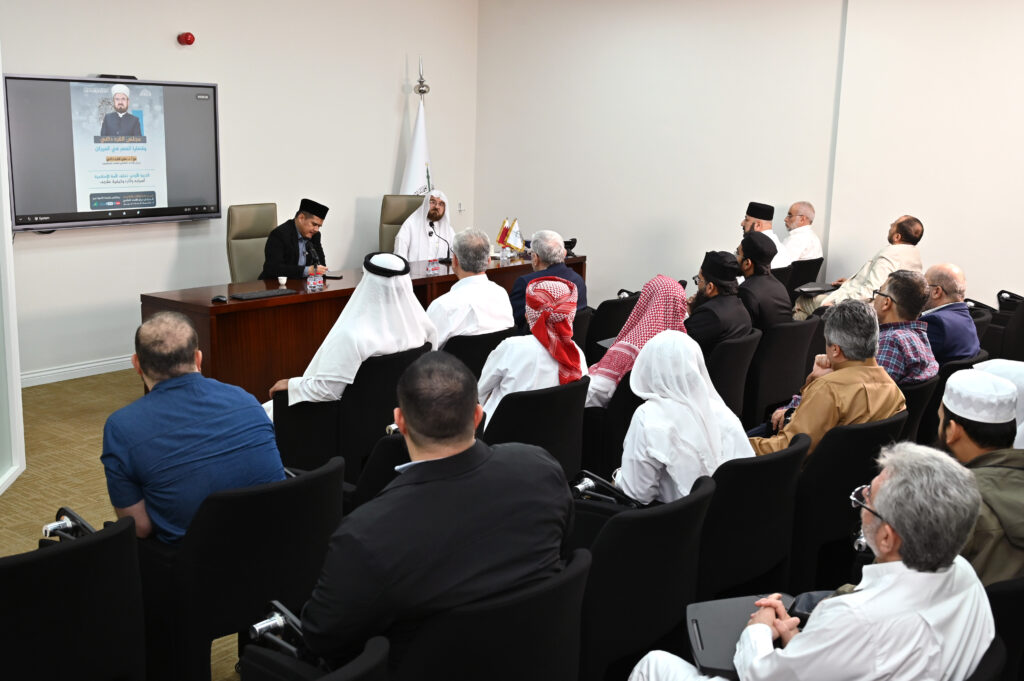
On Saturday evening,
Sheikh Jassim bin Mohammed Al Thani Hall at the headquarters of the
International Union of Muslim Scholars hosted the first seminar of the Council
of His Eminence Sheikh Dr. Ali Mohiuddin Al-Qaradaghi, President of the Union,
as part of a new series of sessions for the current season. The event was
attended by a large gathering of scholars, professors, researchers, and
students of Islamic knowledge.
The Major Challenge
The seminar bore a
highly significant title: “The Backwardness of the Islamic Ummah: Its Causes,
Effects, and Ways of Addressing It.” It focused on discussing the most
prominent challenges facing the Ummah and how its points of weakness can be
addressed in order to advance the levels of science, values, and knowledge.
His Eminence
emphasized that backwardness is not absolute but relative, depending on a
comparison between the current reality and the optimal level that the Ummah
could reach across various fields.
Manifestations and Causes of Backwardness
The seminar
addressed manifestations of backwardness as revealed by recent studies and
statistics, including poverty levels and weak spending on scientific research.
It stressed that economic growth alone is insufficient to drive progress;
rather, it requires adopting a comprehensive development theory as proposed by
Islamic thought, with a focus on education, knowledge, and values.
His Eminence also
discussed the stages of backwardness, beginning with absolute backwardness in
all fields, moving through relative backwardness in specific areas, unplanned
and random movement that fails to achieve clear goals, and finally
one-directional movement under the control of a despot.
Lessons from History
The Sheikh
highlighted the factors that contributed to the European renaissance,
explaining how the Islamic Ummah can benefit from these lessons while relying
on the rich sources of knowledge it possesses.
He stressed the
necessity of addressing backwardness through the Fiqh al-Mizan (the
jurisprudence of balance), which harmonizes between religion and worldly life
in order to achieve genuine development.
Open Discussion with the Audience
Before the
conclusion of the seminar, His Eminence opened the floor for dialogue with
attendees, responding to key questions that addressed:
· The secret behind the success of the West despite its
reliance on materialistic secularism.
· The permissibility of using zakat to support students
of non-religious sciences.
· The possibility of formulating a practical development
strategy based on an Islamic vision.
· The extent of progress achieved by some Islamic
countries compared to their situation a hundred years ago, despite economic and
technological successes and the expulsion of occupiers.
The seminar
concluded amid wide appreciation from the attendees, who affirmed that these
sessions represent a vital platform for reshaping the developmental vision of
the Islamic Ummah and opening horizons for constructive dialogue on genuine
paths to advancing science, knowledge, and values.
(Source: The Union)
ــــــــــــــــــــــــــــــــــــــــــــــــــــ
* للاطلاع على الترجمة الكاملة للخبر باللغة العربية،
اضغط (هنا).