(17 Ramadan) – The
Day of Al-Furqan and Pivotal Milestones in the History of the Islamic Nation
The seventeenth day of Ramadan
stands out in the Islamic calendar as a pivotal day in the history of the
Muslim nation. It witnessed major events that left deep marks on the course of
history, ranging from a victory that consolidated the foundations of the
emerging Islamic state to major political transformations that altered the
balance of power in the Muslim world.
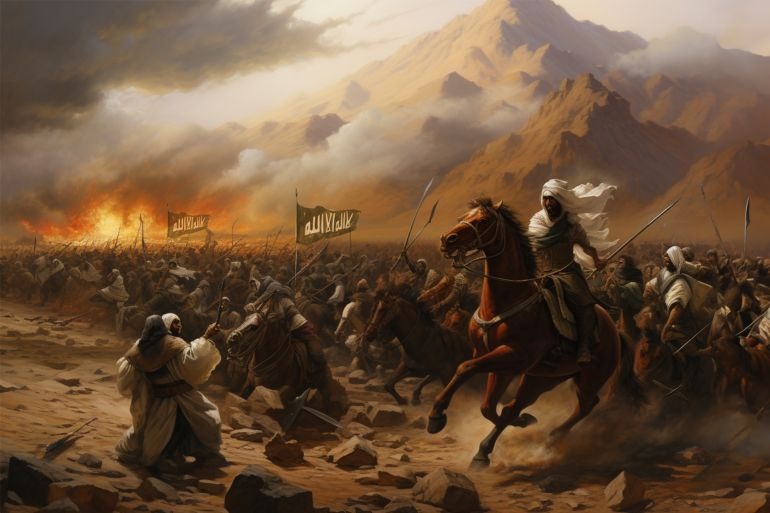
On this day, the Battle of Badr
took place, which came to be known as the “Day of Al-Furqan” (the Criterion).
It is also the day when the fourth Caliph, Ali ibn Abi Talib, was martyred,
alongside other historical milestones linked to Jerusalem and the Mamluk state.
“The Day of Al-Furqan” – A Strategic Turning Point
The Battle of Badr in 2 AH (624
CE) was not merely a passing military confrontation or a skirmish to reclaim a
caravan. Rather, it carried significant strategic dimensions. It came as an
attempt to recover the financial rights of the Muhajirun (the emigrants) after
the Quraysh had confiscated their properties in Mecca. It also aimed to exert
pressure on the Meccan economy and disrupt the trade route between Mecca and
the Levant.
The battle clearly demonstrated
the principle of military consultation (shura). The Prophet Muhammad ﷺ changed the army’s position following the
advice of the companion Hubab ibn al-Mundhir to gain control of the water
wells. A command shelter (arish) was also built based on the suggestion of Saad
ibn Muadh. During the confrontation, divine support descended to strengthen the
believers’ hearts, and the battle ended with the killing of several prominent
Quraysh leaders who had spearheaded opposition to the Islamic call.
The Death of Ruqayyah, the Prophet’s Daughter – Joy of Victory
Mixed with Grief
While Medina awaited news of
victory at Badr, Ruqayyah, the daughter of the Prophet Muhammad ﷺ, known as “the one of the two migrations,”
was passing away. Her husband Uthman ibn Affan was absent from the battle by
the Prophet’s order so he could care for her.
The joy of victory among Muslims
was thus mixed with sorrow over the loss of the Prophet’s daughter. She was
buried in Al-Baqi Cemetery before the Prophet ﷺ
returned from the battlefield of Badr, in a deeply human moment that
accompanied the first great victory of the Islamic mission.
The Martyrdom of Ali ibn Abi Talib – The End of the Rashidun
Caliphate
On the seventeenth of Ramadan in
40 AH (661 CE), Ali ibn Abi Talib, the fourth of the Rightly Guided Caliphs,
was assassinated, bringing the era of the Rashidun Caliphate to a close.
The incident resulted from the
extremism of certain members of the Kharijites, who targeted leading figures of
the Muslim community in protest over the issue of arbitration. Their plan
succeeded only in Kufa, where Ali received a fatal blow while praying in the
mosque’s محراب (prayer niche) during
fasting, at the hands of Abd al-Rahman ibn Muljam.
With his martyrdom, power passed
to the Umayyad state, marking a historic transition between the Rashidun
era—based on consultation and ascetic leadership—and a new phase characterized
by hereditary rule and political centralization in Damascus.
Jerusalem Between the Abbasid and Fatimid Caliphates
The seventeenth of Ramadan in
490 AH (1097 CE) also witnessed an important political shift in Jerusalem,
where control of the holy city represented a cornerstone in the struggle for
legitimacy between the Fatimid Caliphate in Cairo and the Abbasid Caliphate in
Baghdad.
At that time, the Seljuk Turks
served as the military arm of Baghdad, while Jerusalem was under the rule of
the Artuqids (Banu Artuq), who were affiliated with the Seljuks.
However, the Fatimid vizier
Al-Afdal Shahanshah exploited the weakness that struck the Seljuk state
following the death of Sultan Malikshah and the internal conflicts that
followed. He launched a move that brought the city back under Fatimid
influence.
The events ended with Jerusalem
being peacefully handed over to Al-Afdal Shahanshah. The Artuqids departed
toward Diyarbakir in northern Syria, and the name of the Fatimid Caliph
Al-Musta’li بالله was once again
mentioned in the Friday sermon at Al-Aqsa Mosque after a long absence.
Despite the apparent brilliance
of this victory, historians consider it a strategic defeat, as the expulsion of
the Artuqids deepened political divisions within the Muslim world. This
weakened the unified front against the Crusader campaigns, which reached the
walls of Jerusalem less than two years later. The city eventually fell in 492
AH (1099 CE), when a major massacre was carried out within the precincts of
Al-Aqsa Mosque.
The End of Baybars al-Jashankir’s Rule
On this same day in 709 AH (1310
CE), the rule of Sultan Baybars al-Jashankir came to an end after a brief
period that lasted no more than a year and a half.
The title “al-Jashankir”
referred to his former position in the Mamluk court, where he served as the
official responsible for tasting the Sultan’s food to ensure it was free of
poison. He rose to power during a period of political turmoil that followed the
departure of Sultan Al-Nasir Muhammad ibn Qalawun to Al-Karak and his temporary
abdication of the throne.
However, his rule did not gain
broad popularity, particularly as it coincided with famine and a drop in the
Nile’s water levels. The public blamed him for the economic hardships, and
people famously chanted against him:
“You
brought us hunger and dryness, O Jashankir.”
Source: Al Jazeera
ـــــــــــــــــــــــــــ
* للاطلاع على الترجمة الكاملة للخبر باللغة
العربية، اضغط (هنا).