Indonesia
Leads “Green Islam”: Eco-Friendly Mosques and Religious Initiatives to Combat
Climate Change
In the world’s most
populous Muslim-majority country, religion is playing an increasingly
significant role in addressing climate change. The city of Garut, in western
Java, has announced the construction of its first twin eco-mosques, whose walls
will be made from 12 tons of recycled plastic and 24 tons of rice husks.
The project is
supported by the local “Pesantren Walis Asih” Institute, which has
successfully persuaded around 200 neighboring families to adopt a “zero waste”
approach and aims to cultivate a generation of “peace and change makers.”
The institute’s
director, Irfan Amali, stated that transforming waste in this manner “will
contribute to saving thousands of trees.”
Indonesia, where
Muslims make up approximately 88% of the 284 million population, faces
increasing climate challenges, including rising sea levels and devastating
storms, alongside a massive waste crisis of over 11.3 million tons of
non-recycled waste in 2024, according to the Ministry of Environment.
Green Mosques and
Eco-Friendly Models
The country has
witnessed a notable shift in environmental behaviors within Islamic practices
since the beginning of this decade.
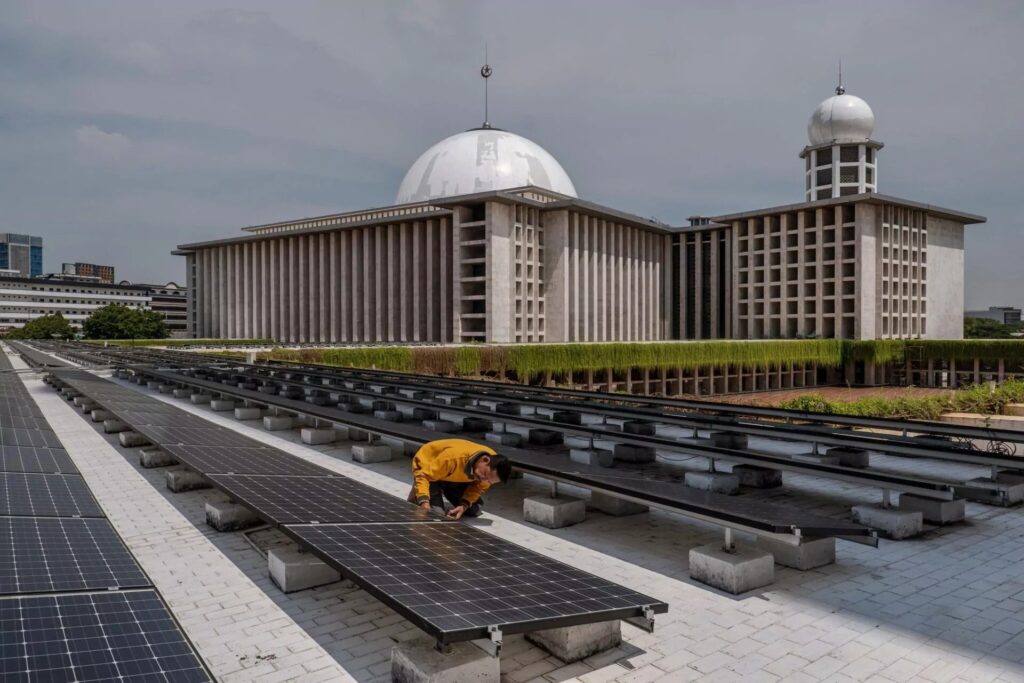
Jakarta’s Istiqlal
Mosque, the largest in Indonesia, has become a low-carbon model after being
equipped with solar panels and a water recycling system. In 2022, it received a
“green” rating from the World Bank and hosted the first Islamic conference for a
“Sustainable Indonesia.”
At the same time,
the Islamic Studies Center at the National University launched the
“Eco-Pesantren” program to integrate environmental issues into curricula.
Activist Rahma
Shafiana from Greenpeace affirmed that the “Green Islam” movement has gained
significant momentum in recent years, noting the support of Minister of
Religious Affairs Nasruddin Umar, who also serves as the Grand Imam of Istiqlal
Mosque, due to his progressive vision on climate issues.
She added that the
organization seeks to promote funding for renewable projects through Islamic
financial instruments and zakat.
Islamic Financing
and Green Bonds
Indonesia is also a
pioneer in issuing sovereign green bonds since 2018, with a cumulative value of
$6.9 billion, despite some fossil-fuel-related projects continuing to receive
funding from public and private Islamic banks, which apply less stringent environmental
and social standards.
Role of Major
Islamic Organizations and Mining Controversy
Environmental
protection is supported by the country’s two largest Islamic organizations,
Nahdlatul Ulama and Muhammadiyah, which together have over 70 million members
and play prominent roles in education, health, and social work.
However, controversy
arose after President Joko Widodo, shortly before the end of his term in June
2024, granted these organizations coal mining concessions, citing financial
empowerment, a decision that drew widespread criticism.
In January,
Nahdlatul Ulama established a company to manage 50,000 hectares of these
concessions in eastern Borneo.
It is worth noting
that the Indonesian Ulema Council, the country’s highest religious authority,
issued a fatwa in 2011 prohibiting environmentally destructive mining
activities.
However, a video
released by Greenpeace in June 2025 revealed the scale of nickel exploitation
in the biodiverse-rich West Papua archipelago, sparking widespread debate.
(Source: News
Agencies)
ـــــــــــــــــــــــــــــــــــــــــــــــــــــــــــــــــ
* للاطلاع على الترجمة الكاملة للخبر باللغة العربية،
اضغط (هنا).