Libyan
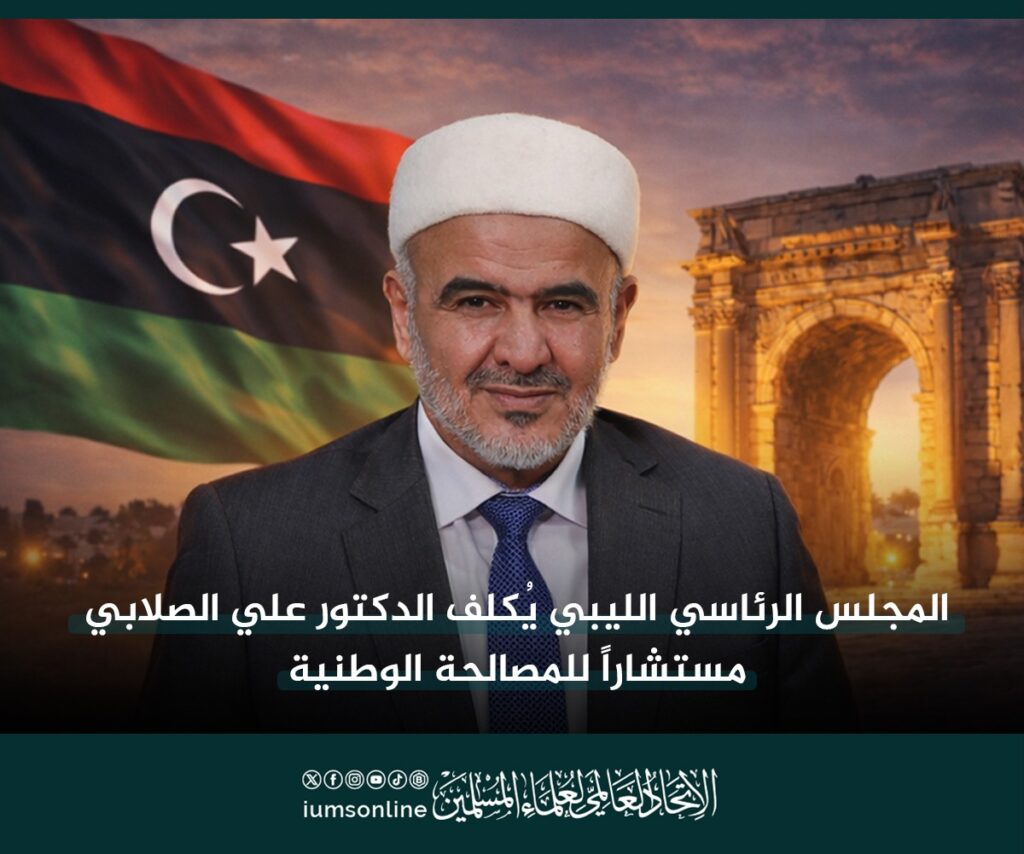
Presidential Council Appoints Dr. Ali Al-Salabi as Adviser for National
Reconciliation
Tripoli – Libya
The President of
Libya’s Presidential Council, Mohamed Younes Al-Menfi, has issued Decision No.
(11) of 2025 appointing Dr. Ali Mohammed Al-Salabi as Adviser for National
Reconciliation, in an official move aimed at reviving the reconciliation file
amid the country’s ongoing political deadlock and division.
The decision is
based on the Libyan Constitutional Declaration and its amendments, the
Political Agreement, the outcomes of the Libyan Political Dialogue Forum, as
well as the laws and decisions regulating the work of the Presidential Council,
in line with the requirements of the current stage.
According to the
decision, Dr. Al-Salabi will directly oversee the national reconciliation
portfolio, with all relevant authorities obliged to implement the decision.
A
Longstanding Approach to Reconciliation
Dr. Ali Al-Salabi is
widely known for his long-standing and in-depth involvement in issues of
reconciliation and national dialogue, making this appointment the culmination
of an extended trajectory rather than a sudden development.
He played an early
role in the “intellectual revisions” experience involving leaders of the Libyan
Islamic Fighting Group during the era of the late Colonel Muammar Gaddafi—an
initiative that marked a significant shift in approaches to violence and political
action, and helped establish dialogue as an alternative to confrontation.
Following the
February 17, 2011 revolution, Al-Salabi continued his efforts to promote
national reconciliation through initiatives and meetings that brought together
leaders and components of the Libyan political landscape, seeking to heal
divisions and overcome the consequences of conflict.
He has also been
noted for his positions in support of the Libyan people, consistently calling
for adherence to the will of citizens and rejecting the transformation of
political disagreements into armed conflicts or avenues for foreign
intervention.
High
Stakes at a Critical Juncture
Al-Salabi’s
appointment comes at a critical moment, amid stalled political tracks,
declining trust among rival parties, and persistently fragile economic and
security conditions.
The Presidential
Council is counting on his experience and broad domestic and international
relations to reactivate the national reconciliation file, which is widely
viewed as a key entry point to achieving lasting political stability.
However, the success
of this initiative remains contingent upon the availability of genuine
political will among all parties, their readiness to make real concessions, and
their acceptance of the Libyan people as the ultimate reference and source of
legitimacy.
Academic
Background and Achievements
Dr. Ali Mohammed
Al-Salabi is regarded as one of Libya’s most prominent contemporary scholars
and thinkers, specializing in Islamic history. He has produced major scholarly
works addressing pivotal periods in Islamic history, with a focus on the
jurisprudence of historical patterns and civilizational experiences.
His publications
have gained wide circulation and have been adopted by various Arab and Islamic
educational and research institutions.
Alongside his
academic activity, Al-Salabi has played a role in Libyan public affairs through
dialogue and national reconciliation efforts, drawing on a religious and
intellectual background that emphasizes consensus and deference to the will of
peoples.
He was also elected
Secretary-General of the International Union of Muslim Scholars, underscoring
his engagement with broader public issues of the Muslim world and his ability
to combine scholarly and institutional work.
A
Divided Political Context
This development
comes amid Libya’s ongoing executive division, with two rival governments: the
Government of National Unity in the west, headed by Abdul Hamid Dbeibah, and
the eastern government backed by the House of Representatives and eastern
military commander Khalifa Haftar.
This division
remains one of the main obstacles to achieving comprehensive national
reconciliation and holding elections that would bring an end to the
transitional phase, rendering Al-Salabi’s mission both highly sensitive and
urgently needed.
(Source:
Arabi21)
ــــــــــــــــــــــــــــــــــــــــــــــــــــ
* للاطلاع على الترجمة الكاملة للخبر باللغة العربية،
اضغط (هنا).