.jpg)
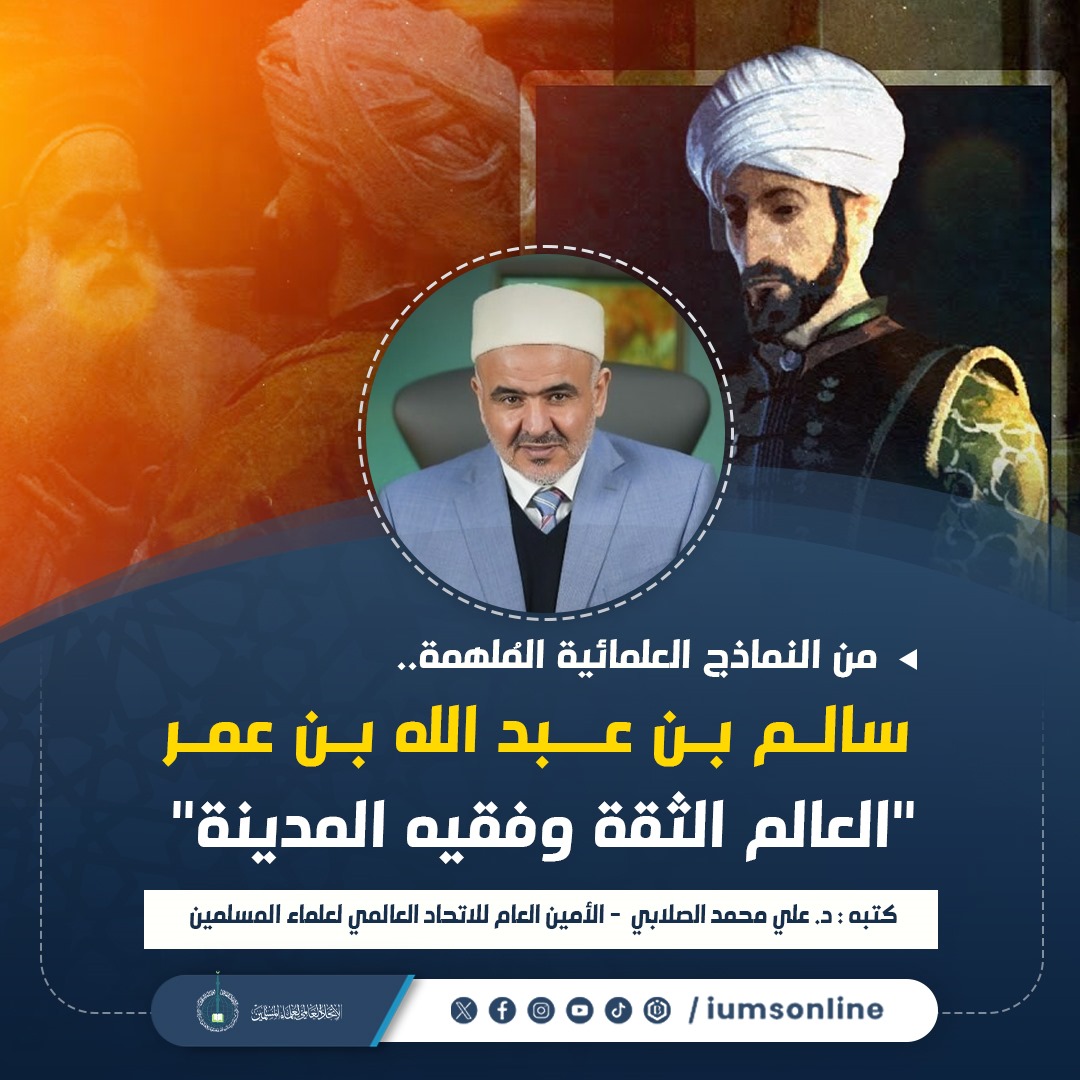
Inspiring
Scholarly Figures: Sālim ibn ʿAbdullāh ibn ʿUmar – A Trustworthy Scholar and
the Jurist of Medina
By: Dr. Ali Muhammad
Al-Sallabi
Secretary-General of the International
Union of Muslim Scholars
Sālim
ibn ʿAbdullāh ibn ʿUmar was one of the seven renowned jurists of Medina, a
leader among the Tābiʿīn, and a trustworthy scholar in the fields of Hadith and
Islamic jurisprudence. Known for his piety and scholarly rigor, he earned the
title of the “Preserver and Jurist of Medina.” Imam Mālik once said, “In his time, no one was more
reminiscent of the piety and virtue of the predecessors than Sālim.”
1. His
Name and Lineage
Sālim
ibn ʿAbdullāh ibn ʿUmar ibn Al-Khaṭṭāb ibn Nufayl ibn ʿAbd al-ʿUzzā al-ʿAdawī
al-Qurashī. His name was chosen in honor of Sālim, the freed slave of Abū
Hudhayfah (RA). Saʿīd ibn Al-Musayyib narrated that ʿAbdullāh ibn ʿUmar said: “Do you know why I named my son Sālim? It was
after Sālim, the freed slave of Abū Hudhayfah.” (Ibn ʿAsākir, Tārīkh
Dimashq, 51/12)
2. His
Early Life
Sālim
was born during the caliphate of ʿUthmān ibn ʿAffān (RA). Although he traveled
to various regions, including Hijaz, Mecca, Medina, and the Levant, he spent
much of his youth in Medina—the city of the Prophet
ﷺ. This environment, filled with Companions and their dedication to
Islamic learning, shaped Sālim’s intellectual and spiritual growth.
The
system of study circles in the Prophet’s Mosque, which became more organized
after the Prophet’s ﷺ passing, further
contributed to his education. Sālim gained knowledge from senior Companions,
and Mūsā ibn ʿUqbah remarked, “Sālim
transmitted an abundance of Hadith from his father and other prominent
Companions.” (Abū
Nuʿaym al-Iṣfahānī, Ḥilyat
al-Awliyāʾ, p. 194).
3. His
Qualities
Sālim
exhibited numerous admirable traits, particularly in his ascetic lifestyle. He
wore coarse garments, eschewed worldly attachments, and lived with minimal
possessions. His profound detachment from material wealth was evident when
Maimūn ibn Mihrān assessed his household and valued it at only 100 dirhams.
(Al-Bashā, Ṣuwar min Ḥayāt al-Tābiʿīn, p. 56(
Sālim
also avoided any association with rulers or their wealth. A well-documented
encounter with Caliph Hishām ibn ʿAbd al-Malik highlights this: inside the Kaʿbah,
Hishām approached Sālim, asking him to make a request. Sālim responded: “I feel ashamed to ask anyone for worldly
matters in the house of Allah.” Later,
when Hishām insisted outside, Sālim replied, “If
it is a worldly need, I will not ask the One who owns it, so how can I ask
someone who does not?” (Ibn ʿAsākir, Tārīkh Dimashq, 22/54))
4. His
Scholarly Contributions
Sālim
ibn ʿAbdullāh was recognized as one of the seven jurists of Medina, whose
collective opinions shaped Islamic jurisprudence. Ibn Mubārak described their
influence: “The jurists of Medina
were seven: Ibn al-Musayyib, Sulaymān ibn Yasār, Sālim, Al-Qāsim, ʿUrwah, ʿUbaydullāh
ibn ʿAbdullāh, and Khārijah ibn Zayd.” They
deliberated collectively on complex legal issues, ensuring that no judgment was
issued without their consultation.
Sālim’s
contributions also extended to Tafsir, though he was known for his cautious
approach. Al-Ṭabarī narrated that ʿUbaydullāh ibn ʿUmar stated: “The
jurists of Medina were strict about Tafsir, including Sālim ibn ʿAbdullāh.” (Al-Ṭabarī, Jāmiʿ
al-Bayān fī Taʾwīl Āy al-Qurʾān, p. 85).
5. His
Role in Hadith Transmission
Sālim
was an exemplary Hadith scholar, narrating from prominent figures such as his
father, Abū Hurayrah, ʿĀʾishah (RA), and Abū Ayyūb al-Anṣārī. Renowned
successors like ʿAmr ibn Dīnār, Nāfiʿ, Al-Zuhrī, and others transmitted from
him. His narrations were widely regarded as authentic, and Aḥmad ibn Ḥanbal
considered the chain of Al-Zuhrī → Sālim → ʿAbdullāh ibn ʿUmar to be among the
most reliable in Hadith studies. (Al-Dhahabī, Siyar
Aʿlām al-Nubalāʾ, 5/132)
6.
His Passing
Sālim
passed away in 105 AH (723 CE), although some sources suggest 106 or 107 AH.
His funeral coincided with Caliph Hishām ibn ʿAbd al-Malik’s visit to Medina,
where the Caliph personally attended and prayed over him. (Ibn Manẓūr, Mukhtaṣar Tārīkh Dimashq).
* References
- Ibn ʿAsākir, Tārīkh Dimashq
- Ibn Ḥajar, Fatḥ al-Bārī
- ʿAdnān Al-Farājī, Al-Ḥayāt
al-Fikriyyah fī al-Madīnah al-Munawwarah - Abū Nuʿaym al-Iṣfahānī, Ḥilyat
al-Awliyāʾ - ʿAbd al-Raḥmān Rāfiʿ Al-Bāshā, Ṣuwar min Ḥayāt al-Tābiʿīn
- Al-Ṭabarī, Jāmiʿ al-Bayān fī Taʾwīl Āy al-Qurʾān
- Muḥammad ʿAjjāj
al-Khaṭīb, Al-Sunnah Qabl al-Tadwīn - Al-Dhahabī, Siyar Aʿlām
al-Nubalāʾ - Ibn
Manẓūr, Mukhtaṣar Tārīkh
Dimashq
-150x150.jpg)